From the Eyes of a Psychiatric Nurse

"When you are listening to somebody, completely, attentively, then you are listening not only to the words, but also to the feeling of what is being conveyed, to the whole of it, not part of it." -Jiddu Krishnamurti

Having spent 35 years as a psychiatric nurse working in inpatient, outpatient, and research settings with children, adolescents, and adults, I have grown to appreciate that attention plays a critical role in the outcome for the patient no matter what the underlying diagnosis. During all of these years, I have witnessed the development of the T.O.V.A. -- from a computer the size of a large refrigerator with an accuracy of +/- 100 ms, to a test using a desktop computer with an accuracy of +/- 1 ms -- and its utility in assessing attention and optimizing treatment. I am proud to continue to be part of the T.O.V.A. team and recall, here, one time of many when the T.O.V.A. helped change a person's life, forever.

Attention: A Family Affair

Joslyn's grandmother made the first call, having heard that I specialized in assessing attention and monitoring treatment. She was concerned that her bubbly, seven-year-old granddaughter, who had been diagnosed with Attention Deficit Hyperactivity Disorder by the pediatrician and started on a psychostimulant, had grown quiet and withdrawn, and that the pediatrician wanted to increase the dosage after the teacher reported some improvement but continued variable attention.

After obtaining written permission from Joslyn's parents, I called the pediatrician, explained my process, and obtained his collaboration. He agreed to continue to follow the medication and was glad to have me provide a closer monitoring of the medication (with the T.O.V.A. and behavior ratings), working with the school and the family. The time limitations of his practice did not allow for more than parental reports and classroom behavior ratings.

Joslyn and I made an agreement that I would help her find the best possible situations to be successful. That meant that I was going to ask her to play a somewhat boring computer game (the T.O.V.A.) before and again 1.5 hours after she took her medication, and a few other times (to objectively assess her attention and the effectiveness of the medication). I let her know that I would be in contact with her teacher and personnel at school and get their ideas of how to support her success (the subjective data). In addition, she would meet and see a colleague of mine with whom she could play and help figure out what would help her in her life (play therapy). I also would meet with her parents (parent counseling) to help them understand how to support her as well.

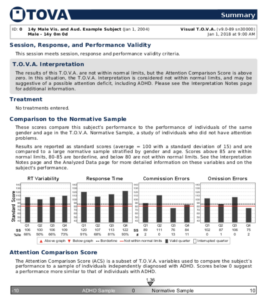
T.O.V.A. Tests: The standard scores for the three tests follow. (<80 is significantly deviant from the norm [], 80-85 is borderline [b], 86-89 is low average, 90-110 is average, and >110 is above average.)

Baseline- no medication

Variable Q1 Q2 Q3 Q4
Variability 69 78* 74* 88
Response Time 77 84b 75 81b
Commissions 82b 79 87 83b
Omissions 105 78 84b 88

The many significantly deviant variables are compatible with an attention disorder. Of interest, the Variability and Response Time are better in quarters 1 & 3 than in quarters 2 & 4. These results could be indicative of anxiety. The consistently low Response Times could be indicative of depression.

On her then current medication: 25mg Ritalin

Variable Q1 Q2 Q3 Q4
Variability 75 61 68 79
Response Time 98 93 101 105
Commissions 86 81b 78 73
Omissions 101 81b 79 86

Response Time is better, and the others are the same or more deviant--especially Variability, the most sensitive measure. In comparison to the baseline, these mixed results are usually indicative of excessive medication. Thus, I recommended that the pediatrician prescribe less (10 mg) rather than more Ritalin.

On 10mg Ritalin

Variable Q1 Q2 Q3 Q4
Variability 110 104 99 114
Response Time 112 109 110 115
Commissions 104 101 107 105
Omissions 105 99 104 110

The results (all within normal range or better) are indicative of a good response to 10 mg of Ritalin.

School: Classroom behavior ratings were obtained and reviewed during a phone conversation with Joslyn's teacher. She explained that she put Joslyn near the door to keep disruption to a minimum when Joslyn left the classroom to get her noon dose of medication. This proved problematic because Joslyn was distracted by noises in the hall and was missing visual cues from the teacher at the front of the room. Joslyn's teacher was happy to make some simple yet necessary adjustments, including moving her desk away from the door (and windows) to reduce distractions and frequently nodding or smiling at Joslyn to refocus her on task. The teacher's ratings confirmed that there had been some improvement but not optimal work completion with 25 mg of medication. These ratings when collected again a month later, after the lowering of the dose and some classroom adjustments, were within normal limits.

Play Therapy: The play therapist who worked with Joslyn reported that she played out her worries and fears about not measuring up to her own expectations and those of her teacher and family. She fully engaged in her play and began to confidently express her needs, wishes, and dreams. She moved from being a quiet, withdrawn little girl to one with energy, humor, and playfulness.

Family/Parent Counseling: Her parents, having been divided on the "fault and cause" of their daughter's struggles, rallied together in support of their daughter. Seeing the objective measures provided by the T.O.V.A. enabled them to join forces and step away from blame and judgment. (The father later came for his own assessment, which had never happened when he was a struggling child.)

The assessment and treatment were a success. Was the T.O.V.A. a major part? Yes. Using the T.O.V.A. gave important, objective measurements that everyone could see through a clearer lens. The pediatrician welcomed the data; I continued to monitor Joslyn's medication every six months, and her dose was adjusted as indicated. The parents were relieved to have guidance and the objective data from the T.O.V.A. in addition to subjective reports and ratings. They were even more relieved that their daughter's medication was decreased, and that her side effects disappeared. The T.O.V.A. report was the first time Joslyn and her parents had received an objective measure of her attention and impulsivity. Along with school and family support, the accurate assessment of her medication needs created a window of opportunity for several changes to occur. Using the T.O.V.A. gave everyone the confidence that they were moving in the right direction and took the guesswork out of her treatment. It ultimately gave her father the strength to ask for help as well—an unexpected benefit—seeing that quantifiable help was available.

Treat your patients with confidence. Use the T.O.V.A. to accurately assess attention, impulsivity, adaptability, and vigilance. Along the way you will become an important resource to the 20% of the population with attention problems, whether ADHD, Traumatic Brain Injury, or other conditions that affect attention.

The TOVA Company—we're here to help.

Carol Kindschi, RN, MSN, serves on the Board of Directors for The TOVA Company. During Ms. Kindschi's long history with The TOVA Company she has gathered data for the T.O.V.A. norming studies, provided clinical support to users, developed educational materials, and served as CEO.

Tags:

Powered by ikiwiki.