The T.O.V.A.® Times - June 2009

In This Issue

  • Identify Malingering with the T.O.V.A.
  • T.O.V.A. Case of the Month

Identify Malingering with the T.O.V.A.

It's an ugly word and an ugly situation that no clinician likes to encounter. Here's how to spot malingering with the T.O.V.A.'s exclusive new Symptom Exaggeration Index™.

Defined in DSM-IV as "the intentional production of false or grossly exaggerated physical or psychological symptoms, motivated by external incentives," malingering is of particular concern when working with teenagers and adults seeking medical treatment for Attention Deficit Hyperactivity Disorder (ADHD) due to the risk of transfer or abuse of stimulant medications.

One study found that almost 50% of treatment-seeking college students showed evidence of malingering (Sullivan, May, & Galbally, 2007). A recent article in the popular press confirms that misuse and frank abuse of stimulants may be rampant on college campuses (see: The New Yorker, April 27, 2009 ).

None of us wants to view our patients with outright suspicion, yet as professionals we play a critical role as gatekeepers for powerful and potentially dangerous medications. How can a clinician working with teenagers and adults complaining of attention problems ensure that self-reported symptoms are truthful?

Self-report symptom checklists are simply not up to the task. As Sullivan et al. found, "...clinicians who rely upon self-report measures in the absence of performance-based symptom validity measures in ADHD assessment are probably risking far more false-positives than they suspect."

So what can you do to ensure that you're treating patients who really need help and not supplying your patient's roommate and friends with "the Adderall™ Advantage?"

It's simple: Use the T.O.V.A. Symptom Exaggeration Index (SEI), available for download from our Clinical Support page. By identifying subtle (but discriminating) signs of exaggeration found in the T.O.V.A. report, the T.O.V.A. SEI gives you the peace of mind that comes from knowing that you are treating those who truly need your help.

Real attention problems are typically confirmed by low scores on the T.O.V.A. As you might expect, exaggerated symptoms also produce low T.O.V.A. scores, but exaggerators are revealed by a number of subtle, yet discriminating "faking bad" signs. Based on the total number of signs, the T.O.V.A. SEI yields an interpretation that ranges from "No evidence of possible symptom exaggeration" to "Almost certain evidence of symptom exaggeration."

A positive history and symptom checklist, converging evidence of problems, poor performance on the T.O.V.A., and a clean score on the SEI confirm that you are likely "good to go" with treatment, and you can use the T.O.V.A. to determine the most effective treatment. You can download the T.O.V.A. Symptom Exaggeration Index worksheet from here, and be sure to watch for the T.O.V.A. Symptom Exaggeration Index in a future version of the T.O.V.A. report!

References

Sullivan, B.K., May, K., Galbally, L. (2007). Symptom exaggeration by college students in attention-deficit hyperactivity disorder and learning disorder assessments. Applied Neuropsychology 14(3), 189-207.

Hughes, S.J., Leark, R.A., Henry, G.K., Robertson, E.L., Greenberg, L.M. (2008). Using the Test of Variables of Attention (T.O.V.A.) to detect deliberate poor performance during assessment of attention. Poster presentation at the annual meeting of the American Academy of Clinical Neuropsychology meeting, Boston, MA).

T.O.V.A. Case of the Month: 19-year-old Student Seeking Treatment

It was all too familiar for a clinician working in the student health center at a Midwestern university: Second semester was well underway, and a 19-year-old, undergraduate student presented with complaints of poor focus, difficulty completing her homework, and the report of a childhood diagnosis of ADHD. She was worried about her grades and asked about medication "for her ADHD" to help her study for midterm exams.

She endorsed every item on a self-report ADHD symptom checklist. She was clearly distressed, and (as she showed the doctor) her grades really weren't that good last semester. Should he wait for her home medical records to confirm a prior history of diagnosis or start treatment right away, to give her the help she seemed to need?

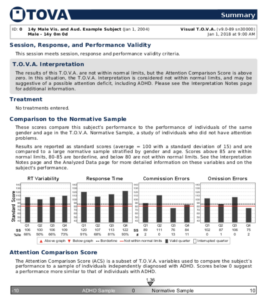
As part of a standard ADHD-referral battery, the doctor administered the T.O.V.A. The results are shown at the bottom of this page.

The T.O.V.A. results show very significant problems with consistency of attention focus, speed of information processing, and vigilance. (For help on interpreting these results, consult our Guide to Clinical Interpretation of the T.O.V.A. available for download from our Clinical Support page, or call 1-800-PAY-ATTN for our free consultation service.) If they're valid, it's no wonder this student is having such a difficult time!

Are these results valid? Before starting treatment, the doctor faxed the T.O.V.A. report to our free clinical consultation service. His main question had to do with the student's apparent slow processing speed. Could this alone be the explanation for her poor academic performance?

During our consultation, we reviewed the full report and completed a T.O.V.A. Symptom Exaggeration Index worksheet with the clinician. The results were remarkable.

This student's T.O.V.A. triggered every possible flag for symptom exaggeration, including overt and subtle signs. These results, such as failure to show post-error slowing or extreme response time variability, are typically not observed in normal subjects or in actual cases of ADHD. (Hughes et al., 2008.) Based on the obtained Symptom Exaggeration Index score, we determined that there was "strong evidence of possible symptom exaggeration."

The clinician was relieved. This finding actually confirmed some of his suspicions. Her performance had seemed "unrealistically bad," and he now had empirical confirmation.

What happened next? The doctor decided to await confirmation of prior findings of ADHD from the student's home medical records and had a discussion with the student about her possible motives for exaggerating symptoms.

How often are you sure that you're getting the "straight story" from patients who self-refer with complaints of poor attention? How would you like to test your hunches with an empirically developed measure that not only confirms the validity of self-reported attention problems but also provides a baseline against which to compare treatment effects? If you're not already a T.O.V.A. user, call the TOVA Company today at 800-PAY-ATTN to find out how you can get started with the T.O.V.A.!

And if you are a current T.O.V.A. user, download our Symptom Exaggeration Index worksheet from our Clinical Support page, and be sure to watch for the T.O.V.A. Symptom Exaggeration Index in a future version of the T.O.V.A. report!

Poor T.O.V.A. Results for 19 year old, college student. Are they for real?

Variable Q1 Q2 Q3 Q4 H1 H2 Total
RT Variability <40* <40* <40* 44* <40* <40* <40
Response Time 70* 45* <40* 61* 55 48* 47*
Commission Errors 98 106 100 102 101 103 102
Omission Errors 43* <40* 81B 57* <40* 60* 45*

Reported as standard scores (average = 100 +/- 15); b = borderline, * = significantly deviant standard score.

Powered by ikiwiki.